
Wednesday, April 26, 2017
Lifelong Learning Applies Here, Too
If I take nothing else away from this course, it's that teaching is an ever evolving practice - similar to MIS and technology disciplines. It's a worthwhile challenge, and it's not one we face alone. In addition to the excellent books and resources from this class (not to mention the people - you all have been fun getting to know), I have developed a personal learning environment to demonstrate where else I can learn about teaching as I continue in my degree program and start teaching.
 This is not comprehensive, particularly on those that list individuals to whom I can turn for advice or help. However, this gives me a good starting point from where to grow and keep learning. With any luck, these resources will lead me to others that are also helpful in keeping abreast of changes in education and trends in teaching. I suppose it's good I enjoy learning and experimenting with new(-to-me) techniques.

Friday, April 21, 2017
Yet Another Fifty: A Book Review of "Classroom Assessment Techniques" by Angelo and Cross
Classroom Assessment Techniques: A Handbook for College Teachers by Angelo and Cross is packed with many great suggestions on how teachers can assess themselves in regards to teaching. It subscribes to the idea that teaching does not occur independently of learning; thus, these techniques mostly rely on gathering feedback in various ways on if and what students are learning. Although some of these techniques may lend nicely to graded work (even if only for participation points), the authors stress that, when applied for the purposes of assessing the effectiveness of teaching, there should be no grade attached to the student feedback.

In addition to a plethora of examples demonstrating how a teacher might undergo an assessment cycle, the authors provide several tables before diving into the classroom assessment techniques (CATs) listing the CATs in various ways. The two I find the most useful are Table 6.2 (CATs recommended for different disciplines) and Table 6.3 (CATs clustered by teaching goal - such as higher-order thinking, basic academic success skills, and personal development). After the CATs are described in full, the authors provide some additional insights into using CATs, including various tables showing how teaching goals vary and are prioritized across disciplines.
I do like that the book includes the teaching goal inventory (TGI) in full; however, it reminds me of the learning goals inventory (LGI) we already completed in class. of the two, I think I prefer the latter. I find the clusters in the LGI more comprehensive and straightforward than in the TGI; I also feel the LGI is more student focused as it puts the emphasis on learning, whereas the TGI is more teacher focused. Perhaps they can be used in a complementary fashion (which may make an interesting book or article for anyone more interested in the subject), and it may be something I spend more time looking at later to really figure out if they're mostly the same or actually complementary.
Other than my uncertainty about the TGI versus the LGI, my one criticism of the text is that some of the CATs seem repetitive. There are a handful that are very similar with more subtle differences. I'm not sure we actually needed 50 CATs - though that seems to be a trend with the books this semester (50 Tips and Strategies from Barkely, 50 Student Engagement Techniques also from Barkley, 55 motivational strategies from Nilson). You would think 50 is a magical number...or that someone just really likes long lists.

Like with Barkley, I think each CAT could start with a succinct bullet list of here's what this is, how to use it, and why you'd use it; it would better facilitate quickly finding an appropriate option. Most of the descriptions convey this information pretty well, but some are very chatty and others are too succinct to be of much use. The plus side, though, is I have a short list of the ones I think may be useful when I start teaching (both as assessment of my effectiveness in teaching and as a, perhaps, biweekly check on student progress in the course). Some of the ones I've jotted down are:
In addition to a plethora of examples demonstrating how a teacher might undergo an assessment cycle, the authors provide several tables before diving into the classroom assessment techniques (CATs) listing the CATs in various ways. The two I find the most useful are Table 6.2 (CATs recommended for different disciplines) and Table 6.3 (CATs clustered by teaching goal - such as higher-order thinking, basic academic success skills, and personal development). After the CATs are described in full, the authors provide some additional insights into using CATs, including various tables showing how teaching goals vary and are prioritized across disciplines.
I do like that the book includes the teaching goal inventory (TGI) in full; however, it reminds me of the learning goals inventory (LGI) we already completed in class. of the two, I think I prefer the latter. I find the clusters in the LGI more comprehensive and straightforward than in the TGI; I also feel the LGI is more student focused as it puts the emphasis on learning, whereas the TGI is more teacher focused. Perhaps they can be used in a complementary fashion (which may make an interesting book or article for anyone more interested in the subject), and it may be something I spend more time looking at later to really figure out if they're mostly the same or actually complementary.
Other than my uncertainty about the TGI versus the LGI, my one criticism of the text is that some of the CATs seem repetitive. There are a handful that are very similar with more subtle differences. I'm not sure we actually needed 50 CATs - though that seems to be a trend with the books this semester (50 Tips and Strategies from Barkely, 50 Student Engagement Techniques also from Barkley, 55 motivational strategies from Nilson). You would think 50 is a magical number...or that someone just really likes long lists.
Like with Barkley, I think each CAT could start with a succinct bullet list of here's what this is, how to use it, and why you'd use it; it would better facilitate quickly finding an appropriate option. Most of the descriptions convey this information pretty well, but some are very chatty and others are too succinct to be of much use. The plus side, though, is I have a short list of the ones I think may be useful when I start teaching (both as assessment of my effectiveness in teaching and as a, perhaps, biweekly check on student progress in the course). Some of the ones I've jotted down are:
- punctuated lectures
- applications card
- paper/project prospectus
- interest/knowledge/skills checklist
- group-work evaluations
- reading rating sheets
- everyday ethical dilemmas (this one I see more as being an assignment rather than an assessment as I'm not entirely sure how knowing the ethical leanings of students will assess my effectiveness as a teacher - if you have thoughts, leave a comment)
- concept Maps
- group instructional feedback technique
All in all, this is another book I will be keeping on my bookshelf for future use. There are tons of ideas for gathering feedback from the people it's perhaps most important to ask: the students.
Wednesday, April 19, 2017
"Let's see how we've come": Final Project Update, Vol. 3
I realize we don't need to do an update for this week because we are meeting Friday night to present our completed projects. However, I have not posted a link to my portfolio and felt that I should. So, without further ado:


Because I love a good Doctor Who reference.

Ta-Da! (Because I also love Disney movies and Stitch is adorable!)
It is currently complete, though there are aspects I will add over the next few years (in addition to updating it as I do my CV). Let me know what you think--either in the comments or Friday night. See you all then!
Friday, April 14, 2017
"Build Me Up, Buttercup": Final Project Update, Vol. 2

The pages and the headers have already been set up (the above snippet is from the homepage); most of the header images are ones I've taken or someone else has taken and given to me. There is no link because there is no actual content in the website, yet. That's the next phase.
Speaking of content, that brings us to the more substantial aspect of my work this past week. I have finished (at least for the time being) the content for the portfolio. This included writing the last of the course descriptions, doing some editing, and identifying the documents to be hyperlinked for each course.
For the time being, I have decided not to include an introductory video of myself on the homepage, though I will probably select a few pictures to include throughout the site. I have also decided not to write a research statement at this time. After doing some research on research statements, and reading a couple of excellent examples from computer science (a related though different field), I determined I am not at a point where it would be worthwhile to write one. The two examples I found actually made me feel a bit like this, to be honest:

In closing, it's building and formatting for the next week (and the presentation...still need to figure out how I'm approaching that). It'll get done...it has to.

Friday, April 7, 2017
"I'm under construction, everyone/so you'll have to mind the mess": Final Project Update
Knowing myself, I have decided to start with the content of my teaching portfolio before starting into work on the website itself. So while I wish I could say this:

it's really the more tedious aspect of actually cobbling together what will populate the pages of my website once I get to that. There are plus sides, though, the primary one being I've been pretty productive at creating and assembling the content! (Yay weekly time set aside for writing projects!)
Here is what I've accomplished in terms of content:
- Updated CV (I hadn't looked at it since last spring and it needed some work...)
- Home page description written
- Teaching Philosophy Statement has been pulled from this blog and slightly revised
- Course list for all doctoral and relevant masters and undergraduate classes compiled
- Most of the course explanations (in terms of content and technologies covered in the course, brief final project description if applicable, and why it's included--for undergrad, mostly) have been written; I've also made notes of which documents will be included, if any
- Outline for the CV pages has been drafted (since I'm breaking that up over multiple pages for future ease of navigation)
So even though I'm still asking myself this:


(and that goes for my two papers that are still hollering for more attention as well...well, mostly the two papers), I am happy with the progress I've made. I'm hoping to finish the content and start into website design next week.
Saturday, March 25, 2017
A Mostly Useful Resource that Fails One of Its Objectives: A Reivew of Nilson's "Teaching at Its Best"
Teaching at Its Best is a resource for anyone teaching college classes, regardless their level of experience--though it's positioned as particularly useful to new professors and those wishing to improve. Its content is based on educational research and experience, covering the gamut from planning and teaching the course to grading and evaluations. It is unlikely to be exhaustive, but it manages to feel like it is.
This brings me to my primary issue with the book. In the preface (page XV in the third paragraph), Nilson writes:
 The biggest failure is that there are no end-of-chapter summaries, followed closely by introductions that are less often illuminating as to the chapter's content than is helpful. While the chapters are thoroughly sectioned and sub-sectioned, many of these are still written to be read. If you tell me right from the start that this book is for people who don't have time to read a book, it should be written as though the person has a day to pick up on the most important parts and highlights of each chapter.
 That said, I do find many of the chapters useful, if not also reminiscent of the Barkley book from last month. Chapter 6 I especially appreciated as this is a topic I hear mumblings about in department offices but no one actually seems to discuss. I also found tables 11.1 and 11.2 useful in summarizing teaching methods; it's an easy tool I can refer to later for guidance and inspiration.
Chapter 24 on feedback was a winner for me, but I also feel like feedback is not discussed enough. I took it upon myself a couple years ago to learn more about giving and receiving feedback because I recognized I was particularly poor at the latter. I wouldn't say I'm great by any means, but I am better than I had been.
 Two aspects of grading that resonated with me were the discussions on bonus points (page 102) and the virtual token system (page 314). On the former, I like that Nilson suggests bonus points should be for those actually putting effort into the class. In one of the classes I TA for, the students have been asking for bonus points, but the ones requesting them don't participate in class--even when the topic is something they're familiar with, like the Internet and myBama--and don't appear to put much effort into their coursework. I acknowledge they probably aren't very motivated to start, but I don't agree with rewarding low motivation with bonus points.
 That said, I like the appeal of the latter, because it fits with my desire to be somewhat flexible. (In general, I'm not sure how I feel about the recommended specification grading approach; I want to like it but it seems impractical in application--though that may be my inexperience talking.) In part, I like the game aspect to it--this may be a business school thing, but I have found many of my classmates over the years to be competitive at times. I also like that it allows students an easy way to request an extension, redo, or make-up without my having to wait for documentation they gave to another professor because they waited beyond the acceptable time frame to inform us they were ill/concussed/at an appointment/etc.

This brings me to my primary issue with the book. In the preface (page XV in the third paragraph), Nilson writes:
...I wrote this new edition for people who don't have time to read a book--like you.If that is an objective, it is one Nilson, in my opinion, fails to meet. This objective makes it sound like the book should be easy to skim, that the main points of each chapter are easily identified and neatly summarized at the end.
Chapter 24 on feedback was a winner for me, but I also feel like feedback is not discussed enough. I took it upon myself a couple years ago to learn more about giving and receiving feedback because I recognized I was particularly poor at the latter. I wouldn't say I'm great by any means, but I am better than I had been.
Switching gears again, I did find some of the chapters uninteresting or unhelpful, and, at times, far too prescriptive. Chapter 4 I found to be the least useful because of Nilson's approach. She essentially tells us teaching should be low tech, at both the beginning and the end. thus negating any argument to the contrary. It also left me feeling like she included it more out of necessity than genuine interest in classroom technology, which discounted her credibility on the topic.
What I enjoyed about Bain and Barkley (see previous book reviews) is they were suggestive and took an approach of "everyone is different so here's some ideas, but do you." Nilson seems to do the opposite, particularly in Chapter 8 when discussing motivation. She suggests that the more of the 55 items you implement, the more motivated your students will be (on average); but that becomes more like a checklist for someone to tick off only to find it isn't that easy. I am untrusting of anything that even hints at being prescriptive.
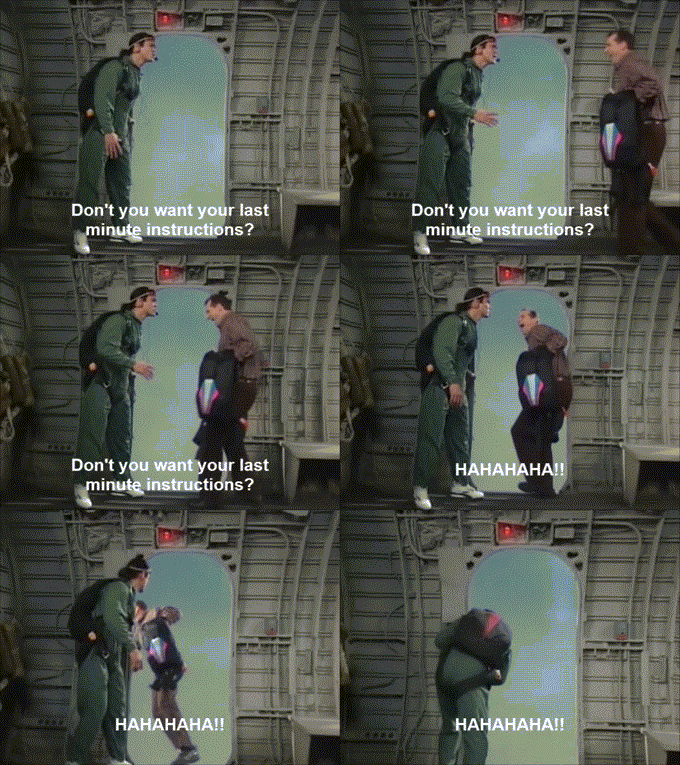
There are also times when the student in me disagreed (rather strongly) with some of the recommendations. In Chapter 12, she provides a section on note taking that reads overly idealistic, particularly as, in my personal experience, distilling a lecture into its important parts doesn't happen in class; it requires time to let the content soak in and be carefully considered. Similarly, the reading tips offered in Chapter 21 are ones I've heard since elementary school; I have tried implementing them at various points in my education and always abandon them because I have not found them to be beneficial; they mostly just double the amount of time I spend on reading, which is already long enough.
I would say 80% of the chapters I found to be useful and insightful. I don't believe this is a book that will be easy to quickly reference for suggestions in the future, though it may be worthwhile to read some of the chapters more thoroughly when time permits. Perhaps my opinion will change on some of these points as I transition from a predominantly student role to more of a faculty/educator role.
Friday, March 24, 2017
A Tool for a Future Job Hunt: Creating a Portfolio for the Final Project
As the title suggests, I have decided to do a portfolio for my final project. This is why I'm forgoing the other options:
- I have two other research papers I'm currently working on (one in the data analysis stage, one in the lit review stage) for two other classes this semester. Voluntarily adding a third paper seemed less than intelligent.
- Although the online certification sounds interesting, and I will likely look into it before graduation, I'm not sure that's a good focus for me currently given the syllabus portion of the option. To do a job I feel would be satisfactory to my personal standard and devote adequate time to my other projects, I would probably need to give up sleep or eating or something like that (especially since I haven't yet been responsible for a class of my own to have some experience from which to draw).
For my portfolio, I will be using either Google Sites or Wordpress. I realize UA has given us access to Portfolium, but I don't perceive that I have the time to spend learning it. I have used various website tools, though, and feel confident in my ability to turn out a fairly nice website. Google Sites is new to me, though I've used many Google programs (I don't imagine it's too different from anything else by Google or other similar programs) and already have an account. That's why it's my top preference. I have used Wordpress previously for a project with the Alabama Small Business Development Center. If Google Sites turns out to be less intuitive than I hope, I'll bite the bullet and create a new account with Wordpress (my previous work did not require I create my own account).
My portfolio will include the following pages:
- Homepage: an introduction to me and why I'm pursuing a PhD in Management Information Systems. This will also provide a brief overview of the content contained within the site. I may possibly do a video here, as well.
- Teaching Philosophy: I will adjust my philosophy post from the blog and include it on the website as its own page.
- Coursework: a listing of the courses I have completed thus far in the program, summarizing what was learned. This is unlikely to include examples of my work as the research papers are ongoing and the other courses used mostly exams and homework--most of which I would not consider substantial.
- Vita: a list of the hyperlinked subsections of my vita will be provided below my contact and educational information. Each major section of my CV will have a separate page.
- Teaching: although I have not yet had a class I was fully responsible for, I have done presentations for various reasons and have lectured occasionally in one of the courses for which I TA. This section will include the work I do as a TA given that it encompasses some tasks related to teaching.
- Research: my one conference proceeding and my ongoing projects will be listed here. I may also include a research statement.
- Service: although I haven't been as involved in service projects this year, I have participated in several during the MBA and before. This will provide a chronological listing of my service activities.
- Organizations and Honors: I am and have been part of several wonderful organizations that I want to acknowledge. I anticipate this being a relatively short page as I'll try to focus on the most important, but I do feel it is important to include.
- Other Experience: despite having little teaching experience currently, I do have extensive experience working with college students through my time in Residence Life and Admissions. I also worked for the Alabama SBDC throughout my MBA program, which involved a form of research. I've decided to include this section in order to highlight the work experiences I have had that do not fit elsewhere within my CV.
I don't see a point in adding an additional "Contact Me" page given that all the information to do so will be within the Vita. Although it is a lot of content, some of it is content I already have somewhere; this will provide a nice opportunity to gather it all in one place. Some of the content will be created specifically for this portfolio (such as everything for the Coursework page and a research statement). All in all, I believe it will be worthwhile to spend the time creating a really nice online portfolio that I can easily maintain over the next several years as I progress in my program. It's not something I've heard of others in my field doing as they go on the market, so it could help me stand out (in a good way) during my job search. Plus, having a website seems appropriate for someone in a technology field.
Subscribe to:
Comments (Atom)