Friday, January 27, 2017

Missing the Practical Implication: Appreciating Bain's Insight while Struggling with Wide-Scale Applicability

Ken Bain's What the Best College Teachers Do provides insight into the practices and mindset of some of the "best" college teachers. The individuals included in this distinguished class were determined through mostly subjective measures; while some may have been supported by more concrete data, others were chosen based on less distinct criteria. This resulted in a diverse sample with remarkably similar approaches to education in college.

On the whole, I enjoyed Bain's work and reading about his revelations about teachers who encourage learning instead of simply teaching. I appreciate the larger themes he introduces, from how to approach planning for classes and establishing high standards to delving into feedback for distributions and using examinations as intermittent gauges of student understanding. I also laud the inclusion of alternate examples from educators who were not selected for the sample to demonstrate more prevalent approaches to college teaching.

One of the comments that most stuck with me is that we don't teach students to read at advanced levels, but expect them to be able to do so. I can relate. Early last semester, I felt like I was drowning in readings. These were not my first academic research readings, but I muddled through them and struggled to 1) stay awake and 2) absorb any of the knowledge I was expected to for seminar. It was through struggling and time constraints that I became a more selective and effective reader (I wouldn't say I'm by any means efficient as it still feels wrong to skip over whole paragraphs or sections that seem to add minimally to the purpose of my reading). Although it is not the thorough reading I would prefer it to be, I can at least feel more confident in contributing to seminar discussions (at least until I feel I've put my foot in my mouth anyway).



Bain also succeeds in organizing a coherent narrative around this topic, despite covering the gamut of classroom activities on the macro level and weaving in perspectives and advice from a selection of the professors in the study. Perhaps the most useful elements of this narrative are the guiding questions for developing an effective learning environment.

Despite the many aspects of the book I applaud, I do find some fault with it. The first is this idealistic notion that universities will act in ways to encourage professors to focus more on learning in the classroom. I could be mistaken, but much of what I've heard about faculty incentives relates to research publications and student reviews of classes are more of a "meet the minimum expectation and you're golden" mentality.


It's similar to the discussion of missing theory in business publications. The journals may say they want to see more theory, but they will continue to publish papers that lack or are weak in theory. (This is not all journals, but there are many that claim to desire strong theory in papers but don't seem to follow through.) Even if the incentive structure is changed, it will take a great deal of time to shift adequate focus to classroom learning at universities because there are so many faculty who are used to the ways things are - and people, in my experience, greatly dislike change.

In a world where such a change is possible, would that be an ideal situation? From the student perspective, taking four classes (even in undergraduate) can be challenging, especially if more than two contain large semester learning projects. To demand high time commitments in all four classes seems unreasonable because you'll likely see some students selectively disengage (not necessarily at any fault to the professor) in order to pick and choose their battles; you may even see a higher stress situation for many students who may already struggle to cope with the course load. An option would be to reduce the number of required courses to be at full time in a semester, but that would mean extending academic programs and there seems to be this negative stigma surrounding the need of more than four years to finish.
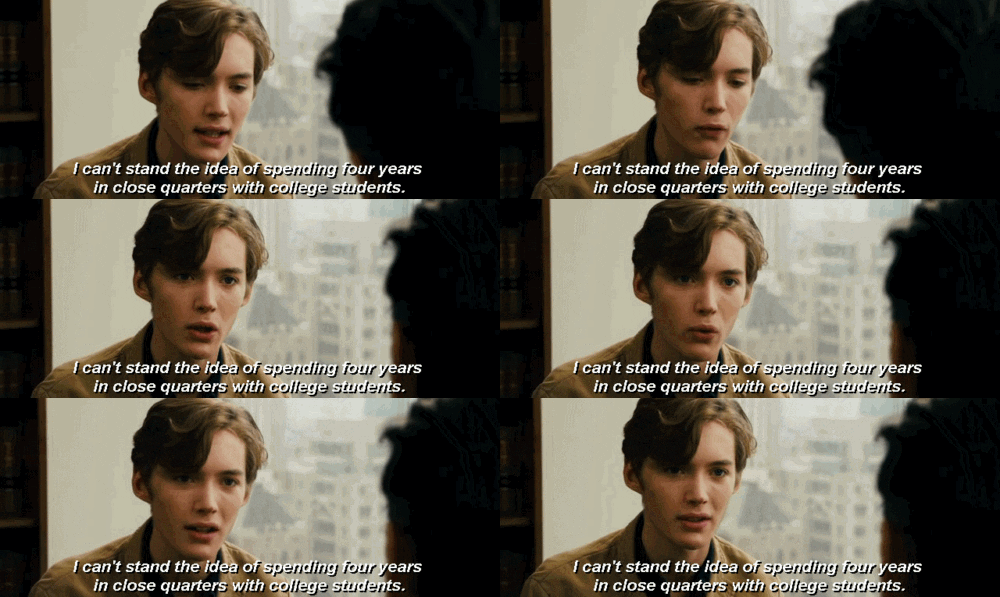
Let alone five...or more...Dad says I have to adult eventually.


From the faculty perspective, this means every course becomes a larger time commitment in meeting with students, grading assignments and exams, and planning lessons. This on top of still needing to further knowledge through research and publications. Oh, and have a life. Some people may be able to balance this well, but others will struggle. Particularly as the approach to teaching would need to become a larger part of hiring decisions and it is likely many existing faculty will either not meet the expectation or will struggle to make the switch. That means fewer qualified educators and more work for those who are.

I agree that there should be more effort and attention given to teaching across a university than what currently exists, but I also acknowledge that not all existing faculty will adopt these methods even if incentivized or required to do so. In part because of the required trade off, meaning there will be some classes in a teaching load that will receive more care and attention than others based on the professor's interests and where he/she is willing to devote energy and time. Examinations, for example, are described as devices the best teachers use to see if students are learning the material; this would seem to exclude multiple choice, fill-in-the-blank, or true/false questions and, instead, require short answer and essay questions - the latter of which requires more time and thought in grading.

These issues with the book may arise from misunderstanding Bain's intent or from my bias as a student and teaching assistant. That said, he incorporates all of these "best practice" approaches into the narrative and seems to encourage adopting a vast majority (if not all) of them while condemning many of the more common approaches in addition to the ones harmful to student receptivity to learning. I know he says there isn't a neat prescription of implement A, B, and C and you'll be a great teacher, but it would have been beneficial to recommend a starting point - something all professors could strive to achieve - or provide a vision of what striving for these best practices might look like at universities given that not all faculty are likely to adopt this mindset. For example, suggesting each professor approach the class mindfully and craft learning objectives in ways that will encourage learning activities throughout the semester. Yes, that will still take time to properly address, but it is something that can be accomplished in every class.

As I mentioned at the beginning, I thoroughly enjoyed Bain's work. Throughout the reading, I found myself identifying past professors who had done some of the things mentioned and considering how I could attempt to apply some of these tactics in my TA work and when I eventually teach my own class(es). My primary concerns stem largely from these questions:
  1. Should every professor be a great professor?
  2. Should every class be a highly involved learning experience?
  3. If so, what changes need to happen in order to make these feasible?
I don't feel Bain adequately addresses these or the practical implications of this research. While fascinating and well-written, I wish he had spent a little more time at the end clarifying how he saw this information being used and applied on a university level.

Sunday, January 15, 2017

Undergraduate Educator Spotlight: Dr. Datha Martinez

My junior year of undergraduate, I spent the first semester in England. When I returned in the spring, it was my first semester taking upper-level marketing courses, the first of which was Retail Management with Dr. Martinez. Of all of the educators I had at Truman, she is the one I remember best. Despite a rather chaotic semester (in general, but in her course specifically, I was on a team that was difficult to motivate which led to me having a breakdown in her office), she made the course memorable with her "Tell me something good" (aka Chaka Khan) Tuesdays, encouraging but no-nonsense attitude, and insistence on treating everyone with formal respect (we were always Mr. or Miss [last  name] in class, which was a departure from our other classes and seemed to demand greater seriousness within class because of it).

I was thrilled to take Marketing Research with her the following semester (a required course) and Selling and Sales Management (an elective). The latter she laced with hands-on experience, including required business professional days (constructive criticism included) and a midterm where we had to role play a sales situation as she played a randomly selected buyer type - she also graded us on our handshake as part of the exam. The former introduced us to a rigorous level of applied research for a local business or campus department. She had recruited the clients and vetted the projects beforehand; my team had the pleasure of being her first team to work with a target population under 18. As such, she assisted us brainstorming how we might approach the assignment in order to receive IRB approval for our research. She continued to be attentive (to the entire class) as we crafted surveys, collected data, and began analysis. I remember going to her office for help interpreting correlations we had run on some of the variables because I could not make the explanation make sense in my head. After that, she asked how the rest of the analysis was going and provided feedback on structuring the final report for her and our client.

Dr. Martinez was easy to talk to and I felt comfortable approaching her whenever I needed an explanation or some advice/support. She wrote recommendations for me while I job-hunted my senior year and when I applied to graduate school initially. I still communicate with her every now and then.

To summarize what made her my favorite instructor:

  • She was stern, but kind. She had standards that she expected us to reach; they may have seemed impossible, but she was there to provide the resources and encouragement we need to realize it was possible.
  • She incorporated applicable learning in the classroom. We still learned from textbooks, but she incorporated practical skills like business dress, handshakes, interacting with a client, and presenting the implications of results. She also encouraged us to stay apprised of what was happening in current business news (which was the focus of Chaka Khan Tuesdays).
  • She treated us as young professionals and supported us as students. Yes, I was always (and still am) Miss Nabity, but I've also cried in her office because I didn't think my team was going to finish our case in the next week since my sections were the only ones done. She responded with compassion and understanding. (For the record, I had every intent to be a reational young professional and not a distraught student in that meeting.)
  • She was an effective and engaging communicator. There are classes I've taken where I remember nothing from being in class because it was a recitation of a slide deck. She knew how to be engaging. (And it wasn't just playing Chaka Khan at the start of class on Tuesdays.) She would incorporate stories, elaborate on the slide deck, and direct questions to specific individuals in the class - both for factual answers and opinions. She made class an experience; one that, if you missed it, you missed a lot more than a regurgitation of the book chapter in slide deck form.
  • She was human. This is a trait I especially appreciate in many educators I've had. By this, I mean they let us peek into their world a little, to know they have a family at home, they have other obligations that may slow response times, etc. It's good to know professors are people, too. I find, even when I've disliked a class with a professor, I often still like the professor as a person if they've allowed us to see them as such.

Saturday, January 14, 2017

An Introduction: The MIS PhD Student

Hello to anyone reading this blog. My name is Teagen Nabity. I am currently the only PhD student in MIS at the University of Alabama (not to be confused with the first, which I'm sure that person graduated many years ago). The good news is, I am not the only person in my classes, as Marketing and Management have graciously allowed me to take many of their 600-level courses - and Marketing, at least, is trying to convince me to convert. Also, we are looking to add one or two more MIS students to the program in the fall, so that's exciting.

Before I go more into my program and what I hope to take away from this course, a little background. My father was in the navy when I was born, so we traveled around a lot for the first six years of my life. After that, he retired and moved the whole family to Grand Island, NE, where I lived until attending college at Truman State University in Kirksville, MO. There, I studied marketing in the business school and spent a semester abroad in England. My study abroad was a learning experience very different from my undergraduate classes and has had an enduring impact on how I approach paper writing.

While in undergrad, I met my now fiance; we met online (but not from online dating - I know, I'm a confusing person; I'll only be more so if you ask about my family). We have been long distance for our entire relationship as he lives in Alabama, and I did not until recently. Even now, we still live on opposite sides of the state.

After undergrad, I worked for TSU as an Admission Counselor in the Kansas City area for a couple of years. I loved working with the students (and sometimes their parents - some parents make it hard to like them, though I understand they're looking out for their kid's interests), but it wasn't a role I wanted for a long time. Traveling all the time and never really being "off the clock" - even on vacation - is hard. Thus, the search for grad school and a career change. At the time, I thought I'd want a specialized masters in marketing analytics or marketing research, as that was a class I adored in undergrad. But UA's MBA won me over, and that's what I pursued.

Through the MBA, I was introduced to MIS and project management for IT teams, which ended up being something I really came to love. It's also how I met Dr. Raja, who approached me with the idea of pursuing a career in academia. She brought me in on one of her current research projects, encouraged me to work with another student to write a conference paper (which was accepted and we presented our poster last month in Dublin), and has thus far mentored me through my first semester of the PhD.

So that's the highlight reel. Now to clarify something you may have been wondering since the beginning: what is MIS? Management Information Systems is a discipline arising from management and focused specifically on information technologies or information systems. It considers how these are developed/implemented/maintained, how people interact with them, data issues (such as quality, cleaning, transformation, etc.) relating to these systems, and so on within a business setting (at least, this is how I've come to understand it to this point). It is a relatively new discipline in the world of business, but one that is growing quickly.

It may be surprising to you that UA has an MIS PhD. That's another fun (see: confusing) explanation. Although the program has existed before now (really, I'm not the first one in it), when they created the program, it was created as a track under Operations Management. Why? I don't really understand it beyond grasping that this was somehow easier to set up quickly. This means, officially, I'm a PhD student in OM; however, aside from the MBA courses I took, I haven't taken OM courses, and I'm not sure I will in the next academic year. Besides, all of the research related work I do is with my beloved MIS faculty - and they are pretty awesome if you've never met them. (And I'm being serious; they're a big part of why I stayed to do a PhD here instead of going out into the great unknown or going back into the work force.)

I realize, at this point, I've already waxed on about myself enough. I want to make one last point, though, and that's to address why I'm taking this course. I've heard from a lot of people in the past year about how academics should focus most of their energy on publications and teaching is a "necessary evil" to earning tenure. I don't prescribe to that line of thinking (about teaching, not about publications). I am in the program because I do enjoy my experience with research and I love the idea of learning something new that will be new to someone else. But I'm also here because I care deeply about education and about influencing students. As I mentioned, working with students was my favorite part of working in admissions (even if they decided to go somewhere else). I loved being that person they were comfortable emailing with questions and asking advice on making their final decision. I've also been very blessed to have had so many great educators throughout my academic career, some of whom I've been able to keep in touch with over the years. They influenced, mentored, and nurtured me as I grew into this person I am today. I know it will be hard (I've been a student long enough to realize what many students are like), but I want that chance to ignite someone's passion, provide guidance, or even just lead by example - for both women and minority students. But to accomplish that, I believe I need to be a competent educator in the classroom. I'm enrolled in this class in order to learn more about what it takes to educate and work on that skill set.