On the whole, I enjoyed Bain's work and reading about his revelations about teachers who encourage learning instead of simply teaching. I appreciate the larger themes he introduces, from how to approach planning for classes and establishing high standards to delving into feedback for distributions and using examinations as intermittent gauges of student understanding. I also laud the inclusion of alternate examples from educators who were not selected for the sample to demonstrate more prevalent approaches to college teaching.
One of the comments that most stuck with me is that we don't teach students to read at advanced levels, but expect them to be able to do so. I can relate. Early last semester, I felt like I was drowning in readings. These were not my first academic research readings, but I muddled through them and struggled to 1) stay awake and 2) absorb any of the knowledge I was expected to for seminar. It was through struggling and time constraints that I became a more selective and effective reader (I wouldn't say I'm by any means efficient as it still feels wrong to skip over whole paragraphs or sections that seem to add minimally to the purpose of my reading). Although it is not the thorough reading I would prefer it to be, I can at least feel more confident in contributing to seminar discussions (at least until I feel I've put my foot in my mouth anyway).

Despite the many aspects of the book I applaud, I do find some fault with it. The first is this idealistic notion that universities will act in ways to encourage professors to focus more on learning in the classroom. I could be mistaken, but much of what I've heard about faculty incentives relates to research publications and student reviews of classes are more of a "meet the minimum expectation and you're golden" mentality.

It's similar to the discussion of missing theory in business publications. The journals may say they want to see more theory, but they will continue to publish papers that lack or are weak in theory. (This is not all journals, but there are many that claim to desire strong theory in papers but don't seem to follow through.) Even if the incentive structure is changed, it will take a great deal of time to shift adequate focus to classroom learning at universities because there are so many faculty who are used to the ways things are - and people, in my experience, greatly dislike change.
In a world where such a change is possible, would that be an ideal situation? From the student perspective, taking four classes (even in undergraduate) can be challenging, especially if more than two contain large semester learning projects. To demand high time commitments in all four classes seems unreasonable because you'll likely see some students selectively disengage (not necessarily at any fault to the professor) in order to pick and choose their battles; you may even see a higher stress situation for many students who may already struggle to cope with the course load. An option would be to reduce the number of required courses to be at full time in a semester, but that would mean extending academic programs and there seems to be this negative stigma surrounding the need of more than four years to finish.
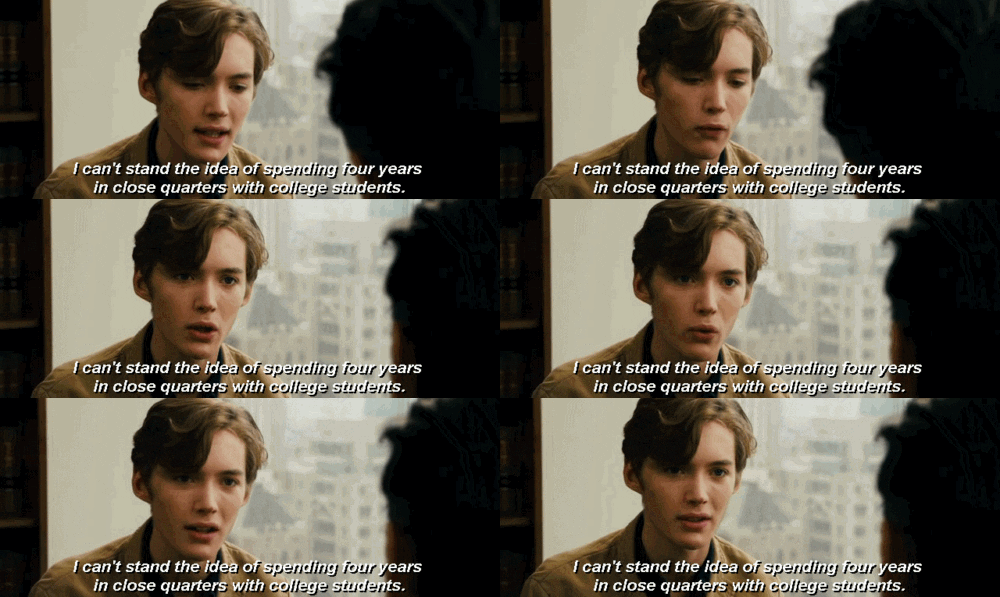
Let alone five...or more...Dad says I have to adult eventually.
From the faculty perspective, this means every course becomes a larger time commitment in meeting with students, grading assignments and exams, and planning lessons. This on top of still needing to further knowledge through research and publications. Oh, and have a life. Some people may be able to balance this well, but others will struggle. Particularly as the approach to teaching would need to become a larger part of hiring decisions and it is likely many existing faculty will either not meet the expectation or will struggle to make the switch. That means fewer qualified educators and more work for those who are.
I agree that there should be more effort and attention given to teaching across a university than what currently exists, but I also acknowledge that not all existing faculty will adopt these methods even if incentivized or required to do so. In part because of the required trade off, meaning there will be some classes in a teaching load that will receive more care and attention than others based on the professor's interests and where he/she is willing to devote energy and time. Examinations, for example, are described as devices the best teachers use to see if students are learning the material; this would seem to exclude multiple choice, fill-in-the-blank, or true/false questions and, instead, require short answer and essay questions - the latter of which requires more time and thought in grading.
These issues with the book may arise from misunderstanding Bain's intent or from my bias as a student and teaching assistant. That said, he incorporates all of these "best practice" approaches into the narrative and seems to encourage adopting a vast majority (if not all) of them while condemning many of the more common approaches in addition to the ones harmful to student receptivity to learning. I know he says there isn't a neat prescription of implement A, B, and C and you'll be a great teacher, but it would have been beneficial to recommend a starting point - something all professors could strive to achieve - or provide a vision of what striving for these best practices might look like at universities given that not all faculty are likely to adopt this mindset. For example, suggesting each professor approach the class mindfully and craft learning objectives in ways that will encourage learning activities throughout the semester. Yes, that will still take time to properly address, but it is something that can be accomplished in every class.
As I mentioned at the beginning, I thoroughly enjoyed Bain's work. Throughout the reading, I found myself identifying past professors who had done some of the things mentioned and considering how I could attempt to apply some of these tactics in my TA work and when I eventually teach my own class(es). My primary concerns stem largely from these questions:
- Should every professor be a great professor?
- Should every class be a highly involved learning experience?
- If so, what changes need to happen in order to make these feasible?
I don't feel Bain adequately addresses these or the practical implications of this research. While fascinating and well-written, I wish he had spent a little more time at the end clarifying how he saw this information being used and applied on a university level.

Definitely interesting points, Teagen. I think you bring up valid concerns. This particularly resonated with me ..."it will take a great deal of time to shift adequate focus to classroom learning at universities because there are so many faculty who are used to the ways things are - and people, in my experience, greatly dislike change." This is so true, and there are, as you say, faculty, who will not implement change even if they are "required" to do so.
ReplyDeleteThe possible shift that I see happening is the focus on recruiting and retaining students. With online learning, students don't have to rely on a local university. They can access less expensive classes from almost any school from anywhere in the world. If enrollment drops off, I'll venture a guess that deans will be looking for answers. Whether or not this will spark change is up to the leadership and the individual professors.
Laura
I agree. It's difficult to put formal teaching evaluation systems in place along the lines of what Bain used for his study. I think we have to hope that faculty members read the book and critically examine their own methods. Bain did mention the idea of a teaching resource center which could help educate faculty members on best practices. We have one here at Berry but it hasn't gotten much traction with the faculty. I've asked a couple of the deans how they know which of their faculty members are the best teachers. They say they get a feel for it by reading student reviews over the years. None have actually watched a faculty member teach. In fact, observation is often viewed as infringement on academic freedom. We have a few faculty members who meet informally and are implementing inquiry-based learning, but there isn't a great deal of emphasis on teaching practices. The majority of the faculty members I know are classic lecturers. Some are very entertaining and a few have quite the student following.
ReplyDeleteTeagen,
ReplyDeleteJust now learning how the blogs work. The previous comment posted at 1:25 was mine by the way. It was showing as unknown.
Mike
Hey Teagen,
ReplyDeleteI found the questions you posed at the end of your post quite interesting, and, as all quite interesting questions, without a clear answer. Oddly enough, the book brought up a similar concern to my mind, although it did differ in one crucial element... CAN every professor be a good professor? Even with the time, and the resources, and with the intentions, I do wonder if there are certain people who are just unable to become good teachers, whether it is because of personality reasons or social reasons or for some other reason I cannot think of at this moment in time. This is probably just me worrying about applying to jobs next year for my potential career path, but I do wonder (and fret that I may be one of them). Thoughts?
All the best,
Tess
P.S. Liked the visuals!
Hi Teagen,
ReplyDeleteThanks for your review. I appreciated your insights and your gifs. I really liked the question at the end. It has never occurred to me to think about whether every professor should be a great one. I mean I get that it's not possible but to question whether it's a goal, that's interesting. So thanks for making me think!