
Full disclosure: I have written the tricky, "I'm so clever" questions, but usually for homework. I know better now.
But if we're honest, what is the point of an exam? If you said to stroke the teacher's ego and make them feel clever and smart:

Exams, quizzes, tests...these assessments should be used as learning tools. They are a chance to assess what has or hasn't been learned. They communicate to students what the faculty member expects them to be learning and understanding in the course. Students should feel like the exam is appropriate, useful, and fair.
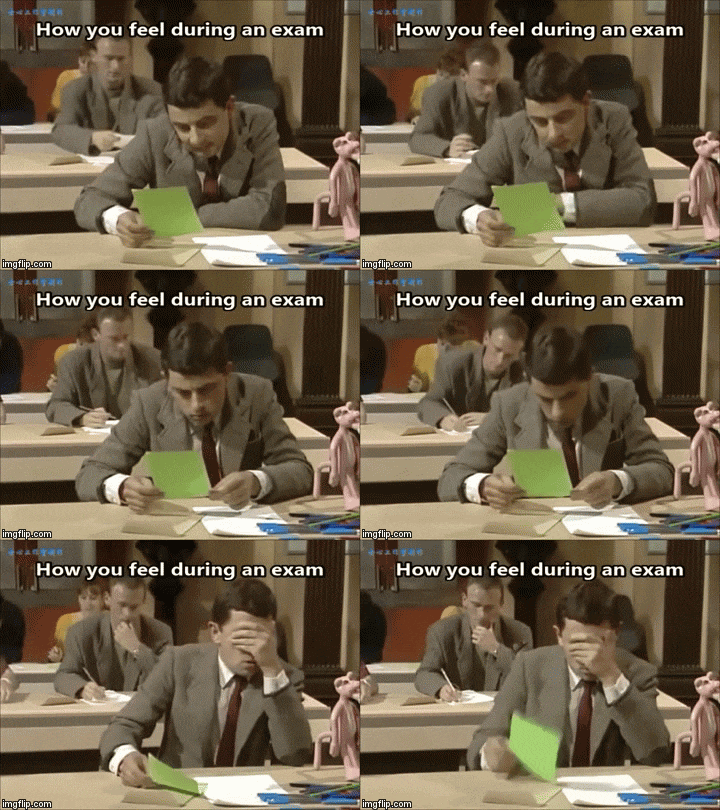
Don't be like my exam last week where we had to learn material barely covered in class in order to complete the take-home portion. Still not amused.
It can be difficult to get out of our own heads and step (back) into the shoes of a student in our class. As such, there is a simple tool you can use to determine if your test is from the black lagoon: exam evaluations. This is no more than five (5) questions you ask students either at the end of an exam or as soon after the exam as possible (preferably before grades are released because, you know, perceptions).

If you're concerned with anonymity, Blackboard and Google forms will let you set up questionnaires and collect data anonymously. Otherwise, it could be a separate sheet to submit with the exam.
This is best used with an assessment that will be given more than once during the course (so final exams are not ideal because there's no benefit to the students if they respond). The questions asked should be specific as it may be difficult for students to express answers that are helpful to improvements if the question is too broad. You should also only ask about aspects of the exam you're willing to change (such as format, question types, etc.), so it's helpful to consider beforehand how you might respond to comments--both in defense of the test and in possible changes to the next one.
When analyzing the feedback, it may be easy to tally answers to each question, but also be cognizant of the content of open responses. These answers provide insight into the frustrations students face (such as trick questions) as well as the perception of fairness of the exam (such as feeling as though the test content was a complete departure from their expectations studying). It is important to separate comments addressing fairness of the test as a learning instrument from those addressing fairness of the grading. While there may be valid points in the latter group of comments, this tool is primarily for assessing the former.
The next time you give a test, consider asking students what they think of it. And not just standing in front of the classroom asking how it went, because it's unlikely you're going to receive the honest, useful feedback you need. If you're serious about improving your assessments for the benefit of your students, it's important to do so thoughtfully and in such a way as to facilitate analyzing and contemplating the feedback.

Go on; let your students be Chuck Norris and help you learn how to improve your exam.
Reference
Angelo, T.A. and Cross, K.P. (1993). Classroom assessment techniques: A handbook for college faculty. San Francisco: Jossey Bass.

Hey Teagen,
ReplyDeleteI continue to love your use of graphics! And, you had some seriously solid advice when it comes to exam evaluations. Honestly, before taking this class, I thought exams were merely ways to evaluate student learning. I had never considered the possibility that students could actually learn while taking the exam. So, with this blurb and the advice from Bain (2004), I've decided to reformulate my exams. I may even, in the future, deliver them online and permit them to be open-note. I have a guess that this may encourage more learning than traditional studying. We shall see!
All the best,
Tess
Hi Teagen,
ReplyDeleteI think this is a good post, and I appreciate that you let your sense of humor show. It's also a nice introduction to exam evaluations. I think it could help to point out that this could be a way to evaluate teaching effectiveness--considering how students feel about the exam as one measure. And since Tess hinted at a testing effect, it could be that teachers or evaluators of teachers could consider how much a student learns from the testing effect.
Hi Teagen,
ReplyDeleteI loved the way you talked about evaluating exams as a learning opportunity for students, as well as, an assessment of how much students have grown throughout a course, and I think that assessing student perception of exams is certainly a useful tool for gauging teaching effectiveness. I wonder how exam evaluations might be structured so that teachers could assess multiple faucets of their teaching ie, whether or not students understand learning objectives, quality of test questions, student growth, and how well learning objectives are assessed through tests and major assignments.